 Korouoma Canyon
Best Time to Visit Korouoma: Ice, Light and Conditions
Last reviewed September 2026
The best time to visit Korouoma is February and March: the icefalls stand at full height, the days are long enough to use, and the trail is still snow rather than slush. Ice starts forming in late October and November, holds through the deep winter, and the last of it at Ruskea virta usually goes at the turn of May and June. December has the ice and almost no daylight; April has the light and a trail turning to glass. Here is what each month actually delivers, and how to pick a departure time around it.
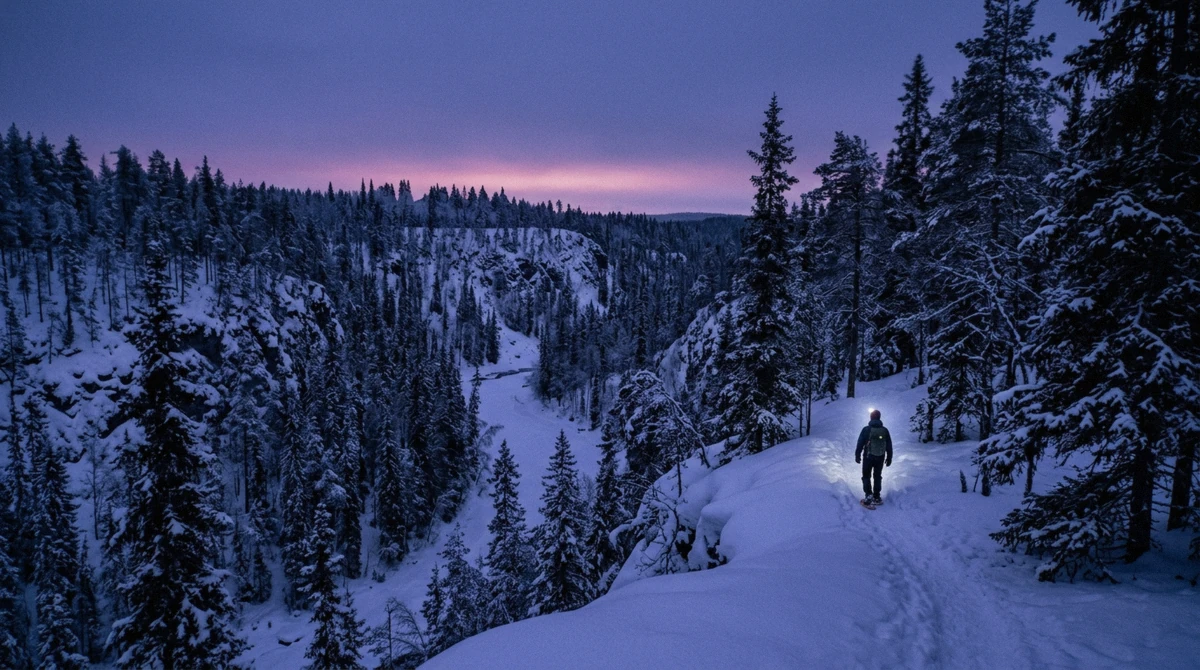
Quick answer The two months that hold ice and light at the same time
February and March are the strongest months at Korouoma: full-height ice, six to fourteen hours of daylight, and firm snow on the trail. Ice begins forming in late October and November, when Ruskea virta can already be climbable in an early frost. December and January deliver the ice with the least light of the year, and April keeps the ice standing while the path turns to slush and glass.
Key takeaways
- February and March: ice at maximum, light usable, trail firm
- Ruskea virta holds ice until the turn of May and June, longer than anything else in the canyon
- In December the sun does not rise at all, so take the morning Korouoma departure
- April walks are still worth it, with grips. What that trail feels like
- Summer is a different place entirely. The green canyon
When the Ice Forms, and When It Goes
Not all six freeze on the same schedule
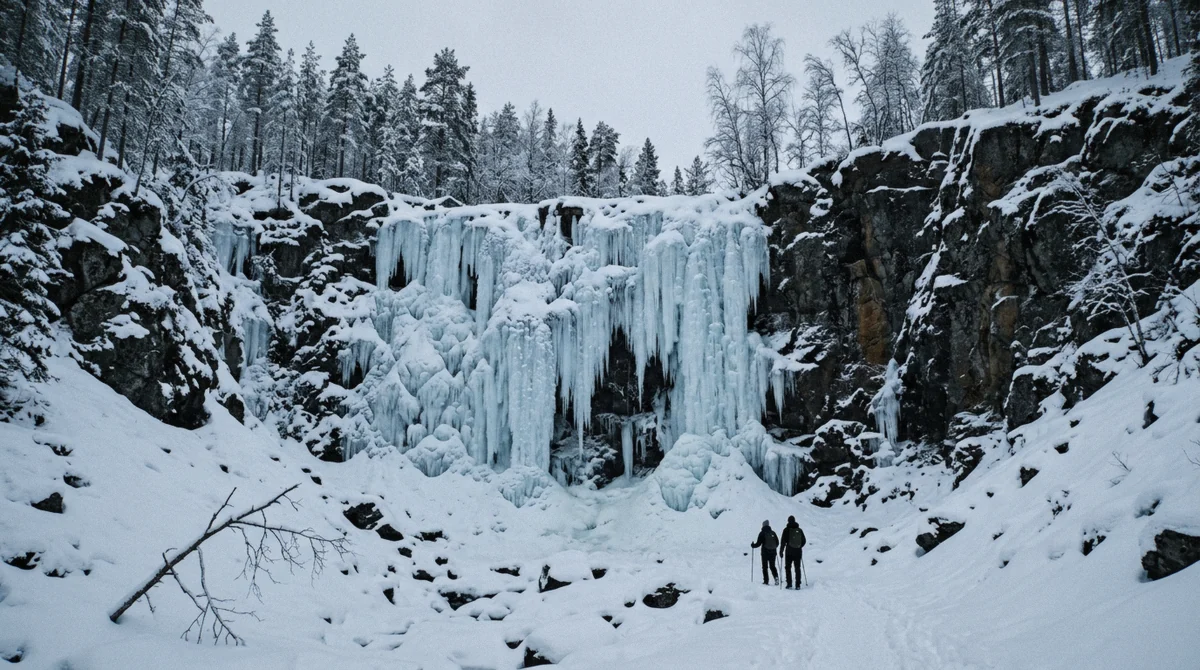
The canyon's ice is spring-fed and stream-fed, and each wall behaves differently. Metsahallitus, which measures them, is specific: Ruskea virta has strong flow all through the winter and can be climbed from the turn of October and November in an early frost, and its last ice usually disappears at the turn of May and June.
Others are conditional. Revontuliputous is fed by water that mostly runs in late autumn, so its ice is thin and flaky most years. Onnekas forms infrequently. Tuulen tie hangs in thin finger-like columns that are not climbable every winter. Mammutti, fed by a spring on Yli-Voho Hill, is reliable and blue.
So the question is not whether the falls are frozen but how many of the six are standing, and that swings with the autumn that preceded your trip.
The calendar, in plain terms
Averages at Posio run from about minus 11C in January to 20C in July, and the ice stands for roughly six months of that, longer than the season the tour listings sell. Month by month, this is what the canyon is doing.
| Month | The ice | The trail | Worth booking? |
|---|---|---|---|
| October | Forming; Ruskea virta possible in an early frost | Bare or lightly snowed | Only for climbers |
| November | Building fast, the smaller falls patchy | First snow, few walkers | Yes, if you want it empty |
| December | Full height on the reliable walls | Good snow underfoot | Yes, with a morning departure |
| January | Maximum, blue and thick | Packed snow | Yes |
| February | Maximum | Firm, well walked | The best month |
| March | Still at height | Firm, refreezing nightly | The best month for light |
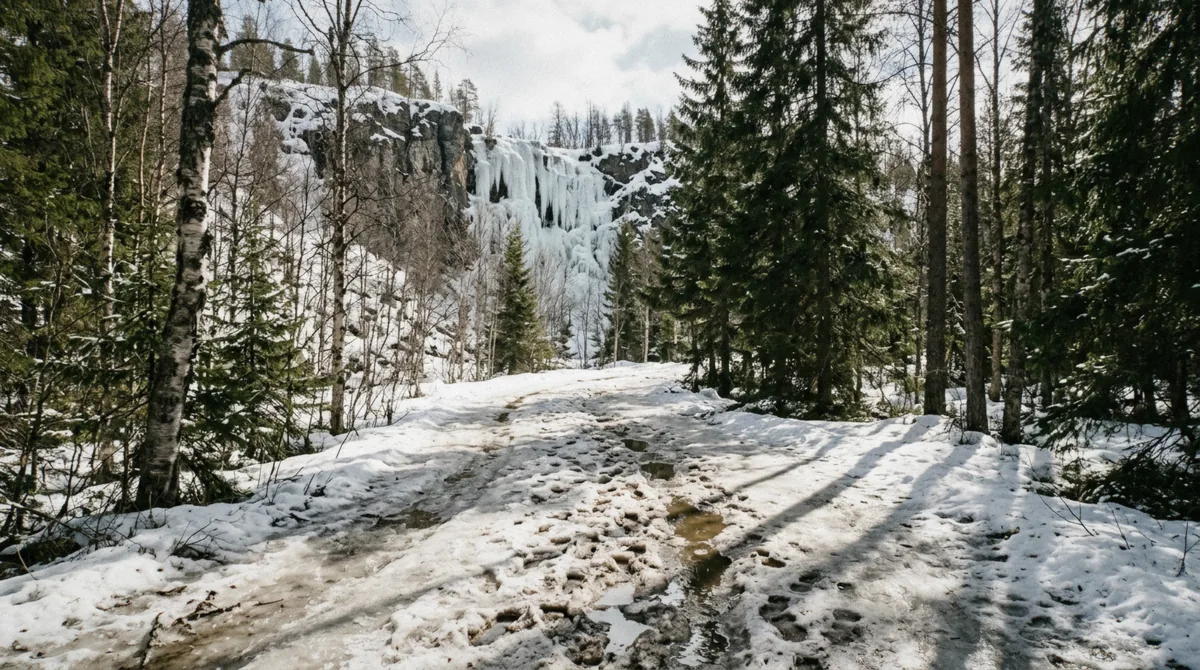
| April | Standing but softening | Slush by day, glass by morning | Yes, with grips |
| May | Only Ruskea virta, going | Wet, patchy snow | Marginal |
Daylight, and Why It Decides Your Departure Time
Polar night is not what it sounds like
Between roughly 3 December and 9 January the sun does not clear the horizon at this latitude. That is not darkness. Around midday there are several hours of blue and violet twilight, and with snow on the ground reflecting most of it, the canyon reads clearly and photographs beautifully in a register you will not see anywhere else.
What it does mean is that a departure time is a real decision rather than a preference. Tours leaving at half past eight arrive as the light comes up and walk out as it goes. An afternoon start in December delivers head torches.
How much light each month gives you
Day length at this latitude swings by more than sixteen hours across the year, and the canyon walls take a further slice off the top and bottom of it.
| Month | Daylight | Usable light in the canyon | Depart at |
|---|---|---|---|
| December | No sunrise, about 4 h twilight | 11:00 to 14:00 | 08:30 |
| January | 2 to 5 h and climbing | 10:30 to 14:30 | 08:30 |
| February | 7 to 10 h | 10:00 to 16:00 | Either departure |
| March | 11 to 14 h | 09:00 to 17:00 | Morning for firm snow |
| April | 15 to 18 h | All day | Morning, before the thaw |
Cold, and what it does to a day out
Average daytime highs at Posio sit around minus eleven in January and February, minus five in March, and a couple of degrees above freezing in April. Reviewers have had minus thirty on the road in April and rain in March; Lapland's averages hide a wide spread.
At minus twenty and below, the fire stop stops being a nice touch and becomes the structural centre of the day, which is worth remembering when comparing the listings that cook a meal against the ones that pour a hot drink. The comparison table marks which is which.
Crowds, and the Rhythm of a Day
When the trail is busy
Korouoma is not a crowded place by any European standard, but it has a rhythm. Guided vans from Rovaniemi arrive between ten and half past, because they all leave town at the same time and the drive is fixed at ninety minutes. That puts six or seven groups on the same loop within an hour of each other, and the fire pits busy at lunchtime.
Arrive before them, which self-drivers can and tours cannot, and the canyon is silent. Arrive after two and most of them are already climbing out.
Weekends, holidays and the ice climbers
Finnish school holidays and the February half-term weeks of several European countries put more vans on the road. Weekends bring climbers, who are worth seeing rather than avoiding: watching a party work a route up Mammutti is the thing that finally communicates the scale of the wall.
Watch from the trail. Metsahallitus asks that nobody stands beneath the falls, because ice and stones come off them, and that includes standing under someone else's route.
Matching the Month to a Departure
What to book when
The month changes which listing makes sense, mostly through daylight and through how much standing still you will do.
| If you are going in | Book | Because |
|---|---|---|
| December or January | A morning small-group hike | The twilight window is short and the fire matters most |
| February | The photographer-guided day | Best light of the winter, and someone else works it |
| March | The longest canyon stay | Enough daylight to use all four hours |
| April | Any listing that supplies grips | The trail refreezes overnight and thaws by noon |
| Summer | No tour is needed | The green canyon is a self-drive walk |
Booking ahead, and how far
February and March weekends go first, and the small-group listings cap at eight seats, so a fortnight ahead is comfortable and a month is safer in half-term weeks. Everything on this site carries free cancellation up to 24 hours before departure and reserve-now-pay-later, so an early booking costs nothing to change.
If your dates are fixed and the canyon is the reason for the trip, book the tour first and the aurora night around it: the canyon days end in the mid-afternoon and the aurora hunts leave at eight. See what runs on your date.
The Other Reason the Month Matters
Korouoma by day, aurora by night
Most people who book a canyon day in Rovaniemi also book an aurora hunt, and the two share a season without sharing a weather requirement. Aurora chasing needs a clear night and darkness, which rules out May to July entirely and makes September to March the working window. The canyon needs cold, which means November to April.
The overlap, November to March, is why Rovaniemi's excursion market looks the way it does. A canyon day ends between half past three and half past four; aurora departures leave around eight. One day covers both without either being rushed, and the seven-hour departures are built around exactly that.
What a bad-weather week does to the plan
A week of heavy cloud kills the aurora and does nothing at all to the ice. Overcast light is in fact the better light for photographing blue ice, because direct sun blows out the white and flattens the colour that makes Mammutti worth the walk.
That asymmetry is worth planning around. Put the canyon on the day the forecast is grey and keep the clear night free for the sky, rather than the other way round. Nothing on this site cancels for cloud.
What Changes in the Pack, Month by Month
Deep winter against spring
In December and January the enemy is standing still: you walk warm and then stop for half an hour at a fire in temperatures where exposed skin is a decision. Extra mittens, a face covering, and a hat that covers the ears matter more than any jacket.
In March and April the enemy is water. Meltwater soaks through boots that were fine in January, the snow gets sticky, and a waterproof outer layer earns its place over a puffy one. Gaiters, rarely mentioned in Lapland packing lists, are genuinely useful on an April descent.
| Month | Biggest risk | What to add | What matters less |
|---|---|---|---|
| December to January | Cold while standing still | Spare mittens, face cover, hand warmers | Waterproofing |
| February | Wind on the rim | Windproof shell, goggles or sunglasses | Extra insulation |
| March | Sun glare off the snow | Sunglasses, sunscreen | Face cover |
| April | Wet feet and glazed ice | Waterproof boots, gaiters, good grips | Heavy insulation |
What never changes
Ice grips in every month of the season, because the trail has no winter maintenance and the reserve says so itself. Water, because there is no water point on the loop. A bag for your rubbish, because there are no bins. Toilet paper, because the dry toilet at the trailhead is no longer maintained.
The full list, including what is worth renting in Rovaniemi rather than flying with, is in the gear guide.
Timing Your Visit: Common Questions
When do the Korouoma waterfalls freeze?
They start in late October and November and build through December. Ruskea virta, the largest, has strong enough flow to be climbable at the turn of October and November in an early frost. The smaller walls need a wetter autumn and a longer cold spell.
Are the waterfalls still frozen in April?
Yes, and often into May. Metsahallitus puts the last ice at Ruskea virta at the turn of May and June. What changes in April is the trail, which thaws in the afternoon and refreezes overnight into a hard glaze.
Is it worth going during the polar night?
If you want the blue-twilight version of the canyon, yes, and take the earliest departure. If you want to photograph the ice in colour, February and March are the months. Both are real trips; they are not the same trip.
How cold does it get?
Daytime highs average around minus eleven in January and February at Posio, with individual days far colder. Guided listings that supply overalls rate their kit to about minus forty, which is a fair indication of the range they expect to operate in.
Do tours cancel because of weather?
They can, and the operator decides. Free cancellation up to 24 hours protects you if you change your mind; an operator cancellation for unsafe conditions comes with a refund or an alternative date. Driving yourself, that judgement is entirely yours.
What is the quietest time on the trail?
Before ten in the morning, and after two in the afternoon, because the guided vans all leave Rovaniemi at the same time and take ninety minutes to arrive. Only a self-drive visit can use the early window.
What month is best for a Lapland trip if the canyon is only part of it?
February and March, on the same logic. They hold full-height ice at Korouoma, they still have long dark nights for the aurora, the snow is deep for everything else in the region, and the daylight is back to a usable length. December has the strongest atmosphere and the shortest days; April is bright and unreliable underfoot. Anything from June onwards is a different holiday entirely.